The Holiday Party Mistakes That Can Leave Massachusetts Hosts Liable
Who's Liable at Your Holiday Party in Massachusetts?
December in Massachusetts means ugly sweater parties, Yankee swaps, office get-togethers and a packed house on Christmas Eve. Whether you're hosting family in Worcester, neighbors on the South Shore, your team at a restaurant in Boston, or friends at your home on Cape Cod, Nantucket or Martha's Vineyard, there's usually one thing at every party: drinks.
Most holiday parties end with nothing worse than too many leftovers. But when a guest has one too many and gets behind the wheel, slips on your icy steps, or gets hurt on the way home from the company party, the question quickly becomes: who's responsible, and whose insurance pays?
In Massachusetts, the answer can surprise people. Hosts, both homeowners and business owners, can be held liable for what happens after a guest leaves. Below, we walk through the scenarios people ask us about most, which insurance typically responds, the myths that get hosts in trouble, and simple ways to keep the season merry and claim-free.
What Massachusetts Law Says About Hosting
Massachusetts is one of the states where a private party host, not just a bar or restaurant, can be held responsible when an intoxicated guest causes harm. This is called social host liability.
Here's the general rule from Massachusetts courts: a social host can be liable if they served alcohol, or made it available, to a guest they knew or reasonably should have known was intoxicated, and that guest then drives and injures someone. The person injured, like another driver or a pedestrian, can bring a claim against the host.
A few important points:
- It's about what you knew or should have known. Courts look at whether the guest was visibly drunk, slurring or stumbling while you kept the drinks coming or let them help themselves.
- Bars and restaurants have their own rules. Licensed establishments that serve an obviously intoxicated person can be held liable under Massachusetts law. That's separate from what applies to you as a private host.
- Minors are a whole different level. Massachusetts law makes it illegal to furnish alcohol to anyone under 21, or to knowingly allow underage drinking on property you control. That can mean criminal penalties on top of a lawsuit.
This article is general information, not legal advice. Coverage depends on your specific policy, carrier and situation.
You host a holiday open house. Your neighbor's brother-in-law has been refilling his glass of bourbon all night and is clearly slurring. He insists he's fine, drives home, and rear-ends another car at a stoplight, injuring the other driver.
Who's liable? The driver first. But because you kept the drinks available to someone you could see was intoxicated, the injured driver may also bring a claim against you as the host.
What coverage applies? The personal liability coverage on your homeowners (or condo or renters) policy typically responds to claims of bodily injury caused by your negligence, including legal defense. The catch: serious car accident injuries can easily exceed a $300,000 or $500,000 liability limit. That's where a personal umbrella policy comes in, adding $1 million or more of protection on top of your home and auto policies.
The guest who slips on the way out
Your cousin steps out at 11 p.m., hits a patch of black ice on your front steps and breaks her wrist.
Who's liable? Potentially you, if the ice was there and you didn't take reasonable steps to clear or treat it. (We covered this in depth in our blog on snow, ice and slip-and-fall liability in Massachusetts.)
What coverage applies? Your homeowners medical payments to others coverage can pay smaller medical bills regardless of fault, and personal liability coverage steps in for bigger claims.
The guest who brings their own bottle
It's a BYOB party. A friend brings his own six-pack, drinks all of it, and drives.
Who's liable? This one is less clear-cut. Massachusetts courts have generally focused on whether the host supplied or controlled the alcohol. If guests only drank what they brought, the host may have a stronger defense. But if you were also pouring drinks, mixing a punch bowl, or the line between "theirs" and "yours" got blurry, that defense gets weaker.
What coverage applies? If a claim is made, your homeowners personal liability coverage would typically respond, including paying for your legal defense.
The guest who says "I'll just crash on the couch"
A guest stays over, gets up in the middle of the night, falls down your basement stairs and is hurt.
Who's liable? It depends on whether there was a hazard you knew about, like a broken railing or a burned-out light.
What coverage applies? Homeowners medical payments to others and personal liability. Remember, injuries to people who
live in your household generally aren't covered under your liability coverage, but overnight guests are not household members.
Scenario 2: Teens and College Kids Home for Break
"We weren't even home"
Your 19-year-old is home from college and has friends over while you're at a holiday party of your own. Someone grabs beer from the garage fridge. One of the friends drives home and crashes.
Who's liable? This is one of the most serious situations a Massachusetts parent can face. Anyone under 21 is a minor for alcohol purposes, and Massachusetts law prohibits furnishing alcohol to minors or knowingly allowing them to drink on property you control. Not being home doesn't automatically get you off the hook, especially if the alcohol was easy to access. Your child may face liability too.
What coverage applies? Your homeowners personal liability may respond to the injury claim, depending on the facts and your policy language. But insurance doesn't cover fines or criminal penalties, and some policies exclude certain intentional or illegal acts. This is a situation where coverage questions get complicated fast, which is why prevention matters most.
"I'd rather they drink here where I can watch them"
Some parents host the after-party for their teens and their friends, take the car keys at the door, and figure it's safer than kids drinking somewhere else.
Who's liable? The intention may be good, but in Massachusetts, providing alcohol to other people's underage kids exposes you to criminal charges and civil lawsuits. Taking car keys doesn't change that, and it doesn't prevent injuries from falls, fights or alcohol poisoning.
What coverage applies? Don't count on your insurance bailing you out. Even where liability coverage applies to an injury claim, it won't cover criminal penalties, and the damages from an injured or killed young person can far exceed typical limits.
Agent tip: If you have young drivers or college students at home, an
umbrella policy is one of the smartest, most affordable protections you can buy. Also make sure any household member who drives is properly listed on your auto policy.
Scenario 3: The Office Holiday Party
The employee who drives home after the company party
You own a small business in Framingham and host a holiday party at your office after hours. You stock the bar, and an employee drinks heavily, drives home and causes a crash.
Who's liable? The employee, and potentially your business. As the host who provided the alcohol, your business can face a social host claim, and because it was a company event, the injured party may argue the employee was acting in connection with work.
What coverage applies? Many commercial general liability (CGL) policies, including most Business Owners Policies (BOP), include host liquor liability. This covers businesses that serve alcohol at events but aren't in the business of selling it. But it has limits:
- It generally applies only if you're not charging for drinks. Selling drink tickets or running a cash bar can push you outside that coverage.
- It doesn't apply to businesses that make, sell or serve alcohol as part of their operations, like restaurants, bars, breweries and caterers. They need liquor liability coverage.
- Wording varies by carrier, so confirm it's on your policy before the party, not after.
If the employee was driving their own car on company business, your hired and non-owned auto coverage may also come into play. And a commercial umbrella adds extra limits over your GL and auto.
The employee who gets hurt at the party
During the office Yankee swap, an employee trips over a tangle of extension cords running to the light-up decorations and breaks an ankle.
Who's liable? If the party is considered work-related, for example on company time, at the workplace, or if attendance was expected, the injury may fall under workers' compensation, which is generally the employee's exclusive remedy against the employer in Massachusetts.
What coverage applies? Your workers' comp policy. If the party was truly optional and off-site, whether it counts as work-related can be debated, so talk to your agent ahead of time.
The vendor or client who gets hurt
A client you invited slips on spilled punch in your office and hurts their back.
Who's liable? Your business, if the spill was a hazard you knew or should have known about.
What coverage applies? Your commercial general liability policy, which covers bodily injury to non-employees on your premises.
Scenario 4: Hosting at a Restaurant or Event Venue
"The restaurant is serving, so it's their problem"
You book a private room at a restaurant in Hyannis for your team's holiday dinner and run an open tab. An employee leaves intoxicated and causes an accident.
Who's liable? The restaurant has its own responsibility as a licensed establishment, and its liquor liability insurance would typically respond for over-serving. But that doesn't mean your business is automatically off the hook. You hosted the event and paid for the drinks, so the injured person's attorney may name your business too.
What coverage applies? The restaurant's liquor liability for their part. For your business, your commercial general liability (including host liquor liability, where it applies), plus hired and non-owned auto and a commercial umbrella where relevant.
Holiday Party Liability Myths, Busted
Myth: "They're an adult. If they drink and drive, that's on them." The driver is responsible, but in Massachusetts, a host who served a visibly intoxicated guest can share the liability. Adult guests don't automatically take the host off the hook.
Myth: "My homeowners policy only covers things that happen inside my house." Personal liability coverage on a homeowners policy generally follows you and your household members, not just your property. It can respond to a claim tied to a party you hosted even if the accident happened miles away.
Myth: "My liability limit is plenty." A serious drunk-driving accident can involve hospital stays, surgeries, lost wages and lifelong care. Those claims can easily top $500,000 or $1 million, well beyond most homeowners liability limits. Anything above your limit can come out of your savings, home equity and future earnings.
Myth: "My business insurance doesn't cover parties." Many general liability policies do include host liquor liability for businesses not in the alcohol business. The opposite myth is just as dangerous: "My GL covers everything." Charging for drinks, or being in the food and beverage business, can change that. Check your policy before the party.
Myth: "We hired a restaurant, so we have zero liability." The restaurant has its own liability for over-serving, but the business or person who hosted and paid for the event can still be named in a lawsuit.
Myth: "It's fine if the kids drink here since I took their keys." In Massachusetts, providing alcohol to anyone under 21 who isn't your own child, or knowingly allowing it on your property, can lead to criminal charges and civil liability. Taking keys doesn't change the law.
Myth: "An umbrella policy is only for rich people." Umbrella policies are for anyone with something to protect, including your home, savings, retirement and future income. They're also one of the most affordable coverages per dollar of protection.
Quick Tips for a Safer Holiday Party
- Serve plenty of food. Heavier food and steady snacks slow alcohol absorption.
- Offer great non-alcoholic options. A mocktail or festive punch gives guests an easy alternative.
- Stop serving well before the party ends. Close the bar an hour before people head out and switch to coffee and dessert.
- Hire a licensed, insured bartender. Professionals are trained to spot intoxication and cut people off. Ask for their certificate of insurance.
- Skip the cash bar at business parties. Charging for drinks can affect your host liquor liability coverage. Use drink tickets that limit each guest to a set number instead.
- Have a ride plan. Share rideshare codes, line up designated drivers, or offer a guest room or couch.
- Speak up. If someone is clearly intoxicated, stop serving them and don't let them drive. An awkward moment beats a lawsuit, or a tragedy.
- Lock up the liquor when you're away. Especially with teens or college kids home for break.
- Clear the ice and light the way. Shovel, salt and turn on outdoor lights so guests get to and from their cars safely.
- Review your coverage before the party. Confirm your liability limits and whether host liquor liability is on your business policy.
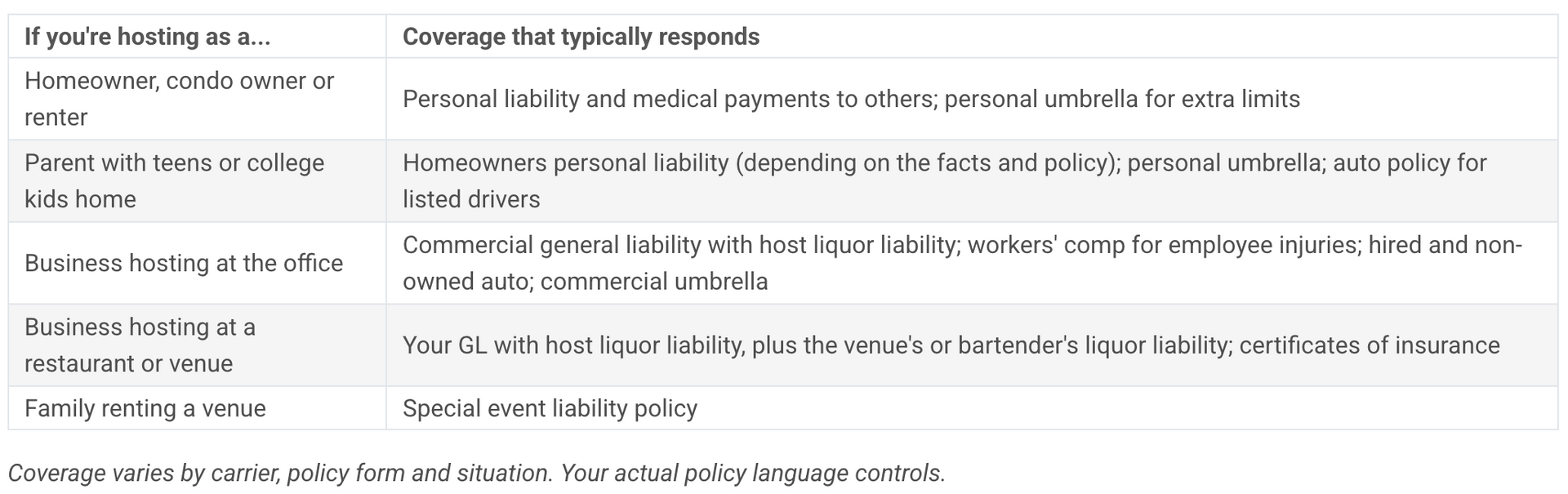
Who Pays? A Quick Coverage Cheat Sheet
The Bottom Line
In Massachusetts, being a generous host comes with real responsibility. Whether you're hosting family on Christmas Eve, your teen's friends over break, or your whole team at a company party, you can be held liable if a guest gets hurt or hurts someone else, and the damages from one bad night can be life-changing. The good news is that a little planning goes a long way, and the right homeowners, umbrella, business and liquor liability coverage can make sure one mistake doesn't put your home, savings or business at risk. Before you send out the invites, take a few minutes to make sure your coverage is ready for the season.
Questions? Talk to a Real Person
Not sure if your homeowners or business policy covers holiday parties? Wondering whether your liability limits are high enough, or if an umbrella policy makes sense for your family? Since 1986, family-owned McShea Insurance Agency has helped Massachusetts families and businesses on Cape Cod, Nantucket, Martha's Vineyard and across the state protect what matters most with home, auto, umbrella and commercial insurance.
Email us at
insure@mcsheainsurance.com or call
508-420-9011 to speak with a real, experienced agent, not a call center. We'll answer your questions, review your coverage, and put together a no-obligation quote.